
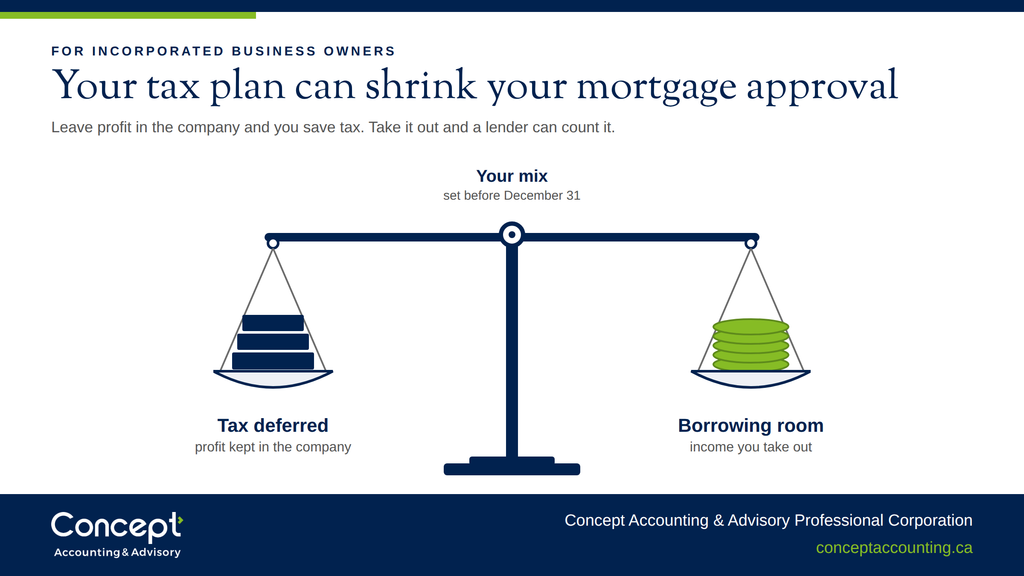
Leaving profit in your company saves tax. It also lowers the income a mortgage lender can use.
If you own a corporation, you probably leave part of each year’s profit inside it. That is often good tax planning. A small company pays a lower tax rate on its business income than you would pay personally. The rest of the tax is paid when you take the money out.
The trade-off shows up when you apply for a mortgage or refinance. Many lenders qualify you on your personal income, and profit left in the company is not part of it. The choices that set your 2026 personal income close on December 31.
In this issue:
- What a lender counts as your income
- Dividends are not the problem
- Leaving profit in the company lowers that income
- Shareholder loan draws are not income
- Some lenders also look at your company
- Before you apply for a mortgage
What a lender counts as your income
For an incorporated owner, many lenders start with your last two years of personal tax returns and Notices of Assessment (the letter CRA sends after it processes your return). They average the total income on those returns and use it to decide how much you can borrow.
That income includes the salary and dividends your company paid you. It does not include profit the company earned and kept.
Dividends are not the problem
Salary and dividends both count as personal income. A dividend from a small company is usually reported on your return at 115% of the cash you received. This is called the gross-up. It turns the dividend back into roughly the profit the company earned before its own tax.
Lenders differ on whether they use the grossed-up amount or the cash you received, so ask yours. Either way, the choice between salary and dividends matters less than how much you take out, and when.
Leaving profit in the company lowers that income
Say your company earns more this year than last year, and you leave the extra profit inside to defer tax. Your personal income stays where it was. Your tax bill is lower, and so is the income a lender can use.
Neither choice is wrong. They serve different goals. Leaving profit in the company defers tax and builds savings there. Taking more out raises the income a lender sees, but you pay more personal tax now. The right mix depends on when you plan to borrow and how much you need.
Shareholder loan draws are not income
Many owners take money from the company during the year as draws. The books record these as a shareholder loan, which is money the company has lent to you. At the company’s year end, the loan is often cleared with a dividend or salary.
Until the loan is cleared, those draws are not income on any tax return, so a lender cannot count them.
Timing can add a second gap. Your company may have its year end in any month, but your personal tax year always ends on December 31. If the dividend that clears the loan is paid after December 31, money you lived on in 2026 shows up as income on your 2027 return.
The draws cannot stay a loan forever. If a shareholder loan is not repaid within one year after the end of the company’s tax year in which it was made, CRA can add it to your personal income.
Some lenders also look at your company
Some lenders go past your personal return. They review the company’s financial statements (what it earned, owns and owes) and its cash flow (the money that came in and went out), and may count part of the profit you kept. Not every lender does this. Ask how a lender will treat your company’s income before you apply, and have the last two years of company financial statements ready.
Before you apply for a mortgage
- Do you expect to buy a home or refinance in the next two years?
- Do you know the total income on your last two personal returns, and how it compares with what your company earned?
- Is there a shareholder loan on the company’s books today, and when will it be cleared?
- Have you decided how much you will take out personally before December 31?
With my clients, I plan how much they take out of the company, and when, with the next two years in view. If a mortgage is coming, we weigh the tax saved by leaving profit inside against the income a lender needs to see.
Your tax plan and your borrowing plan should be one plan.
Concept Accounting & Advisory Professional Corporation | conceptaccounting.ca