
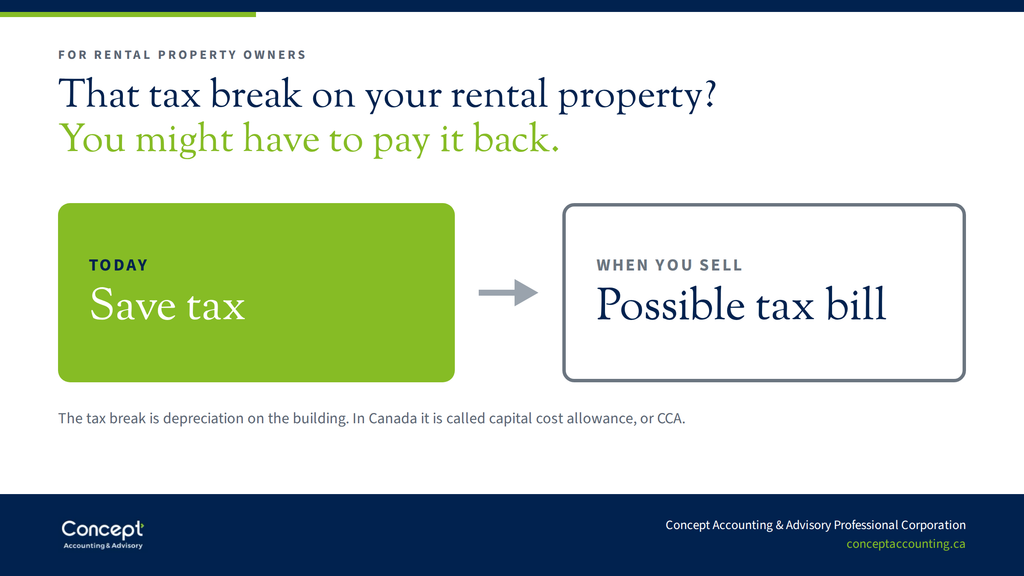
Claiming depreciation on your rental saves tax today. When you sell, you might have to pay it back.
If you own a rental, the CRA lets you claim depreciation on the building. It is a yearly tax deduction for the wear on the building, and in Canada it is called capital cost allowance, or CCA. Many owners claim the full amount every year. That often makes sense, because it lowers the tax they pay right away.
Here is what many owners are not told. CCA usually delays tax. It does not remove it. When you sell, the CCA you claimed can be added back to your income, all in that one year. You decide how much to claim on each return, and your next decision is on your 2026 return, due April 30, 2027. This issue covers rentals you own personally, under federal CRA rules.
In this issue:
- What this tax break is
- You choose how much to claim each year
- Why you might owe tax on past claims when you sell
- Two owners, same rental: the numbers
- When claiming less can save you tax
- How to avoid a surprise tax bill
What this tax break is
A building wears out over time, so the tax rules let you deduct part of its cost each year. That deduction lowers your rental profit, and lower profit means less tax.
Land does not wear out, so you cannot claim it on the land. When you buy a rental, the price is split between the land and the building, and only the building counts.
You choose how much to claim each year
You can claim any amount, from zero up to the yearly limit. If you skip it one year, you do not lose it. You can claim it in a later year.
There is one rule to know. The deduction can bring your rental profit down to zero, but not below. If your rentals, added together, already break even or lose money, you cannot claim it that year.
Why you might owe tax on past claims when you sell
Each claim lowers the value of the building on your tax records. When you sell, the CRA compares what you got for the building with that lower value. If you sold for more, the CCA you claimed usually comes back as income in the year you sell. This is called recapture.
Recapture can cost more than people expect, for two reasons. First, it is taxed in full, like a salary. A normal gain on a sale, called a capital gain, is only half taxed. Second, years of claims come back in one year, on top of your other income. That can push you into a higher tax bracket for that year.
If the building sells for less than its value on your tax records, you can usually deduct the difference.
Two owners, same rental: the numbers
Two owners buy the same rental for $500,000. The land is $100,000 and the building is $400,000. Ten years later, both sell for $700,000. Owner A claims $100,000 of CCA over those years. Owner B claims none.

Owner A saved $30,000 over 10 years, then paid $45,000 in the year of sale. That is $15,000 more tax. In return, Owner A had the use of that $30,000 for years, for example, to pay down the mortgage.
If Owner A’s tax rate had been the same in the year of sale, the $30,000 saved would come back as $30,000 owed, and there would be no extra tax. What matters is your tax rate now compared with your tax rate when you sell.
When claiming less can save you tax
Claiming the full amount is common and often right, especially if you plan to keep the rental for a long time. Claiming less, or none, can save you tax in three cases.
- Your income is low this year and you expect it to rise. The deduction is worth more in a year when your tax rate is higher, and you can claim what you skip later.
- You plan to sell soon. A big claim now can come back, fully taxed, within a few years.
- You rent out part of the home you live in. When you sell your home, you usually pay no tax on the gain because it is your principal residence. The CRA usually lets your whole home keep that status only if, among other conditions, you claim no CCA on the rented part. A claim on a basement suite can cost you more than it saves.
Neither choice is wrong. One gives you lower tax now. The other gives you less tax when you sell.
How to avoid a surprise tax bill
- Do you know how much CCA has been claimed on each rental since you bought it?
- Do you plan to sell a rental in the next few years?
- Do you rent out part of the home you live in?
- Is your income this year lower or higher than you expect it to be in the years ahead?
With my clients, I look at each rental’s CCA history and their plans for the property before we decide how much to claim. That way, the tax break they take each year fits the sale they expect later.
Claim for the sale you plan, not just for this year’s return.
Concept Accounting & Advisory Professional Corporation | conceptaccounting.ca